Storms and safety
Getting north Houston trees ready before the Gulf storms arrive
Beryl and the May 2024 derecho showed which Houston trees fail first. This checklist covers what to look for in spring, what to fix before June, and what to leave alone.
Phone answered 24/7 · office in Spring, TX
By Ursula Lusk, Tree Guides EditorUpdated
 Tree advice
Short answer
North Houston's hurricane season runs June through November, so tree prep belongs in spring. Walk every large tree that can reach the house, take out deadwood and hung-up limbs, thin crowded canopies lightly, check pines for lean and lifting roots, and schedule removal of failing trees before the first storm forms.
What Beryl and the 2024 derecho showed about Houston trees
Two storms, two months apart, tested the same trees. The May 2024 derecho knocked out power to more than 900,000 Houston-area customers. Then Beryl cut power to about 2.26 million CenterPoint customers in July, and CenterPoint said trees across its system had been weakened by three years of freezes, drought and heavy spring rain.
Texas A&M Forest Service estimated that Beryl's wind damage affected about half of the trees across the Greater Houston area, mostly older trees. In Kingwood, 80 mph winds ripped seventy-foot pines out of the soil, crushing cars and roofs. A stressed tree often shows its weak points from the ground first: deadwood, a crack, a root plate already loose.
March to May: the walk-around list
Do the walk in spring, after the hardwoods leaf out, so dead limbs stand out against new green. Stand back far enough to see the whole crown, then walk the base. Anything on this list within reach of the house, the driveway or a line is worth a closer look.
Two or more of these on one tree is the point where a storm-season tree check earns its keep.
- Dead limbs, bare while the rest of the crown has leafed out.
- Hangers: broken limbs caught in the canopy since the last storm.
- Cracks in the trunk or at a tight, V-shaped fork.
- Mushrooms or shelf fungi at the root flare.
- Soil heaving or cracking on one side of a leaning tree.
- Limbs resting on the roof or crossing the service drop.
Thin the canopy lightly, never strip or top it
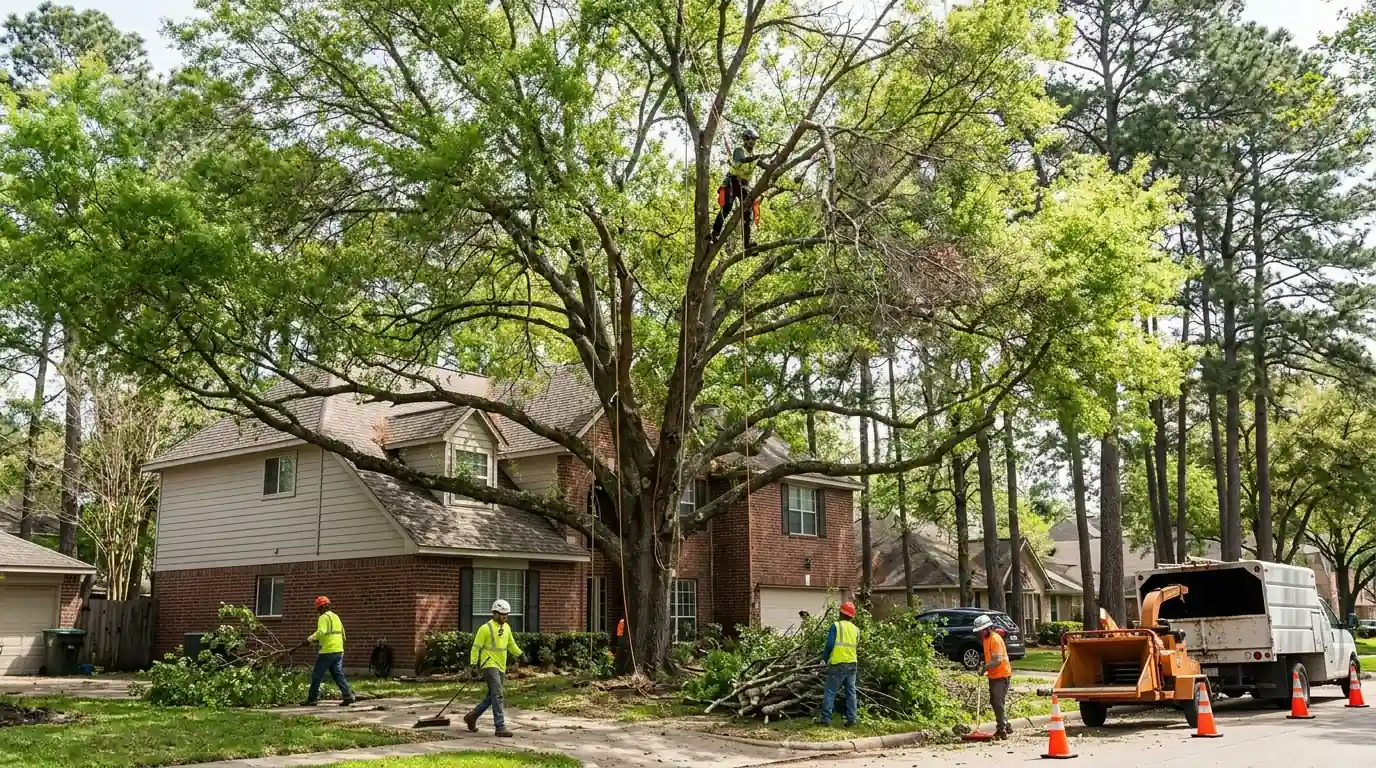
After Beryl, a Kingwood tree contractor told ABC13 the first step before storm season is cleaning out the upper canopy so wind blows through the tree rather than against it. In practice that means deadwood out, crossing limbs out, and a modest share of crowded interior growth thinned evenly through the crown.
Overdoing it backfires. Stripping the inside of every limb and leaving leaves only at the tips puts the weight at the ends, where wind leverage is greatest. Topping is worse: the stubs decay, and the sprouts that replace them attach weakly. Judge pre-season canopy thinning by what stays in the tree, not by the size of the brush pile.
Want a crew lead to walk the yard?
We check the trees that can reach your house, then plan the pruning and removals worth doing before June.Tall pines near the house: lean, root plate and distance
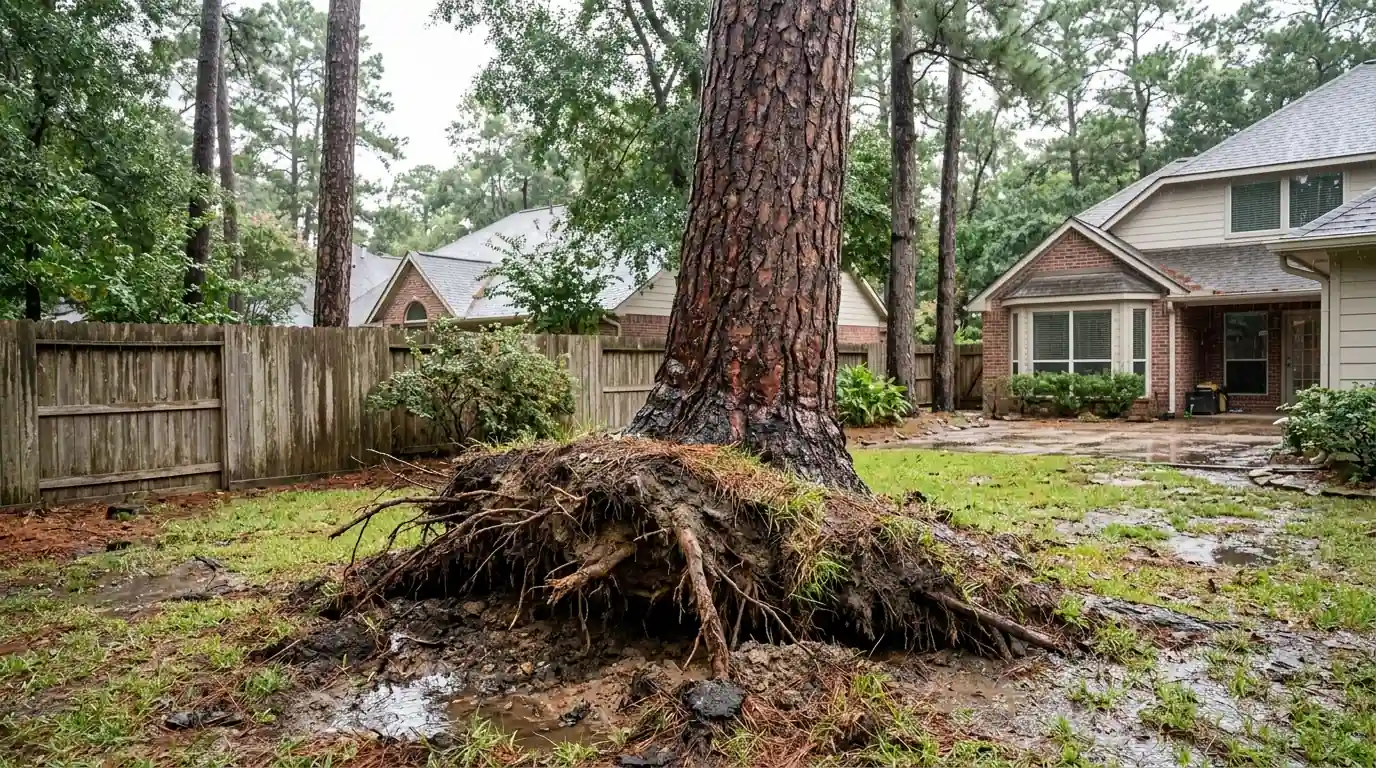
Loblolly pines are the trees north Houston homeowners worry about most, and Kingwood's losses showed why. When a big pine fails in wind, it often goes whole, at the roots or the stem. Watch three things: a lean that has changed, a root plate that lifts when the ground is soaked, and decay or beetle damage in the trunk.
Pace off the distance from the trunk to the house and compare it with the tree's height. A pine taller than that distance can reach the roof if it goes. Freeze and drought stress also left pines open to Ips beetles, as Texas A&M Forest Service warned in 2024, so check the bark for pitch tubes on the same walk. If a tall pine fails these checks, removing the pine before June is far easier to schedule than after a storm.
Roof lines, service drops and palms
Clear limbs off the roof and away from chimneys, vents and gutters. A branch that brushes shingles in a light breeze will grind at them in a gale. Clearance over the roof is sized to the house, not to the shape of the tree.
CenterPoint said most of Beryl's damage to its system came from vegetation outside its rights of way, yard trees included. Limbs over the service drop from the pole to your house are worth clearing before the season, and that work belongs to a crew that plans around energized lines.
On palms, take only dead and drooping fronds and the seed stalks. The so-called hurricane cut, which strips a palm to a few upright fronds, removes the leaves that feed it and does not make it safer.
Only budget for part of the list? Work in this order
Few yards get everything done in one spring. Spend first where a failure would hit people or the house, and leave shaping for a calmer year.
- Dead or failing trees that can reach the house or the drive.
- Cracked forks and hangers over the roof or where people walk.
- Limbs on the roof, the gutters or the service drop.
- Even thinning of the largest crowns near the house.
- Shaping, raising and clearance cuts that are mostly about looks.
When a storm gets a name: the last few days
Once a storm is a few days out, the pruning window has mostly closed. Fresh brush piles become things the wind can throw, and nobody should be climbing in gusts. Use the time to reduce what the wind can hit.
After the wind drops, stay clear of any tree touching a line and treat every downed wire as live. For a tree on the roof or across the drive, our phone is answered 24/7 for emergency tree removal.
- Move cars out from under the largest trees.
- Pick up fallen limbs and loose brush in the yard.
- Photograph the trees near the house as a before record.
- Note which trees can reach the roof, the drive or a line.
Sources
- KTTZ/NPR, Houston power outages after Hurricane Beryl (May 2024 derecho)
- T&D World, CenterPoint restores power after Hurricane Beryl
- Community Impact, Trees for Kingwood (Texas A&M Forest Service Beryl estimate)
- Texas Monthly, Kingwood after Beryl
- ABC13, Kingwood tree damage after Hurricane Beryl
- S&P Global, CenterPoint on post-Beryl restoration and tree work
- Texas A&M Forest Service warning on Ips beetles and hypoxylon canker, 2024
- NOAA National Hurricane Center, Atlantic hurricane season dates
Aim to finish by the end of May. The season runs June through November, and spring work lets dead limbs show against new leaves. Booking early also leaves time to haul the brush.
Not on height alone. A sound, straight pine with a stable root plate and a clean trunk can be left standing. Height becomes the issue when it combines with a lean, decay, beetle damage or a house within reach.
When it is done lightly and evenly, yes. Taking out deadwood and some crowded interior limbs lets wind pass through the crown, as a Kingwood contractor described after Beryl. Heavy stripping or topping works against you.
Beryl's damage fell mostly on older trees, by the Forest Service estimate. Age alone does not condemn a tree, but older trees carry more deadwood, decay and root trouble, so they deserve the closest look each spring.
Have it looked at before June. A crack in a trunk or fork tends to open further under load, and a split tree over the house is a safety question. Cabling sometimes saves it; sometimes removal cannot wait.