Trimming & Pruning on the north side
Getting limbs off north Houston roofs and gutters
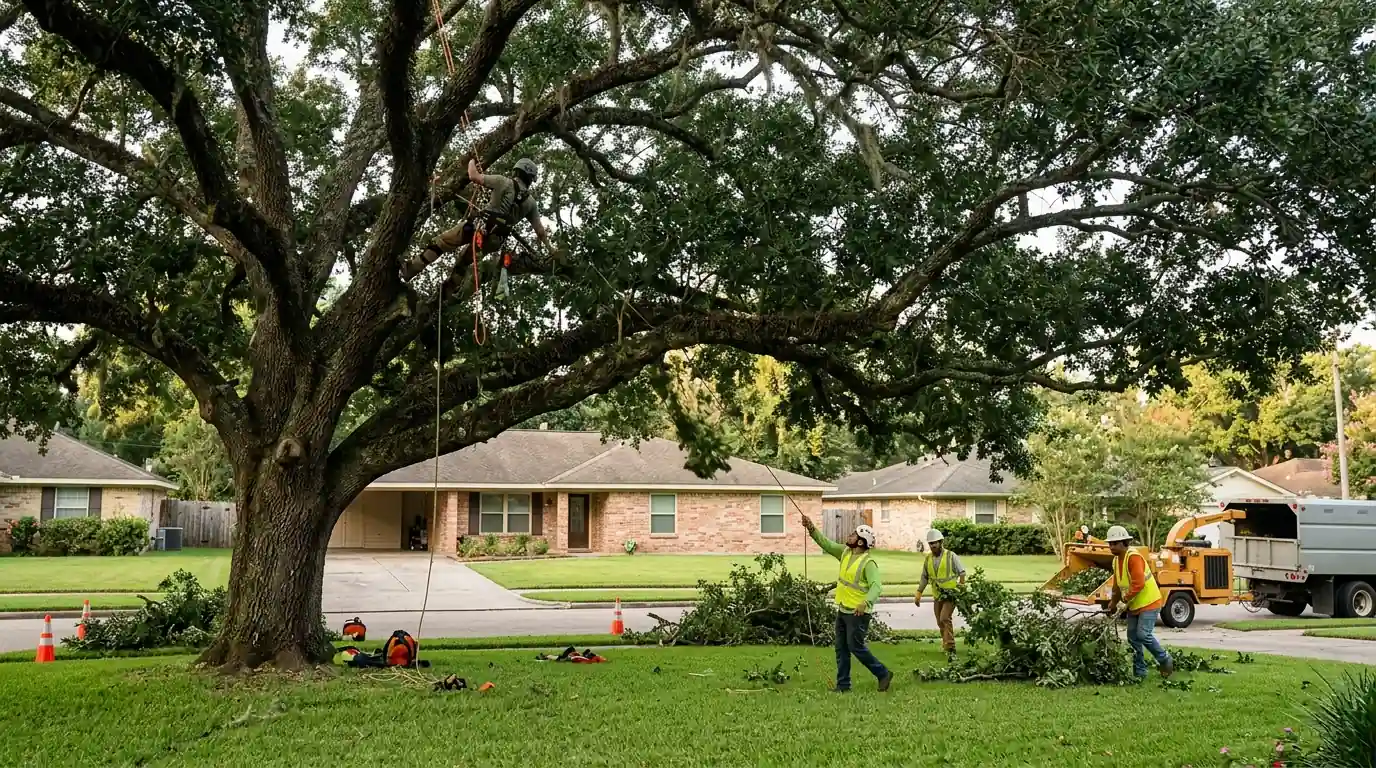
We cut back the limbs that rub shingles, pack valleys with leaves or give squirrels a path to the eaves.
Phone answered 24/7 · office in Spring, TX
- Roofline cuts
- Rope-lowered limbs
Updated October 2026
 Trimming & Pruning
Short answer
Roof limb clearance in Houston is not only a hurricane-season job, since the May 2024 derecho hit before the season opened. We cut limbs touching or hanging over the roof back to a union, and clear what they dropped from gutters, valleys and the chimney.
The job
What limbs do to a roof
A limb resting on shingles grinds off their granules each time the wind moves it, until the bare mat wears through. Leaves and pine needles pack into valleys and gutters and hold water against the shingles. Squirrels use the same limb as a ramp to the soffit.
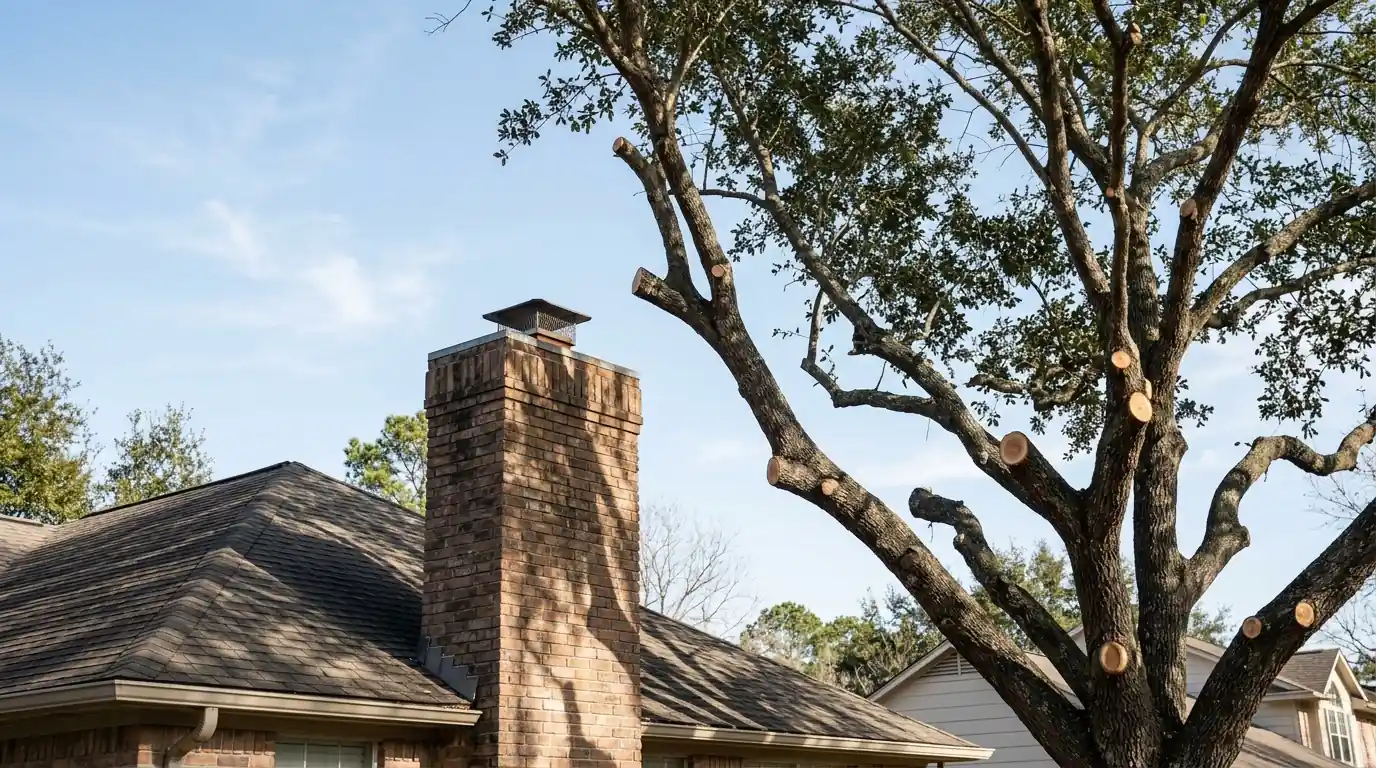
Clearance cuts are sized to the house, not the tree's shape. Each limb goes back to a branch union, never a stub. When a leader leans over the house, crown reduction or a crane removal may serve better.
In the scope
Included in a roofline clearing
- Every limb touching the roof cut to a union.
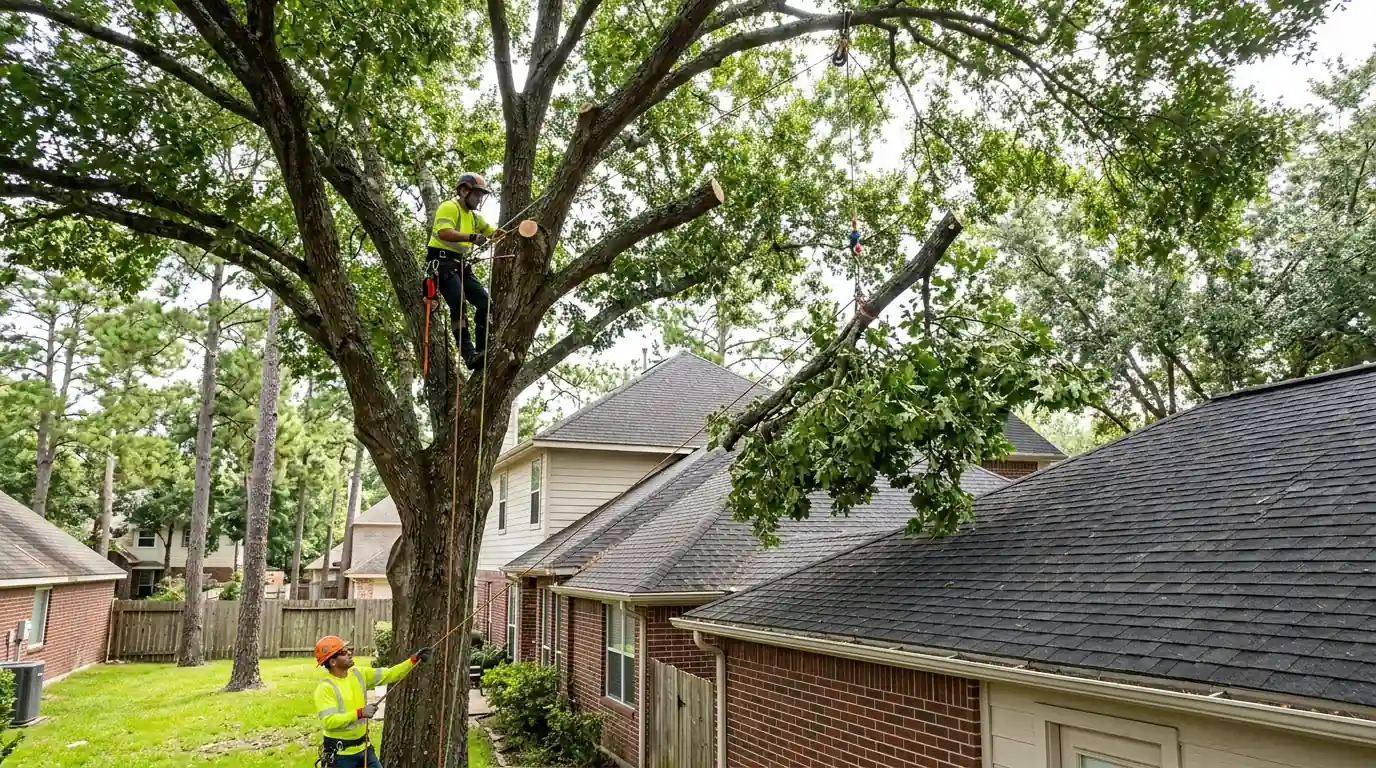
- Limbs roped down clear of shingles and skylights.
- Clearance around the chimney, vents and attic turbines.
- Twigs and leaves cleared off roof and gutters.
- Brush chipped or hauled, and the yard raked clean.
- A closing walk naming the limbs worth watching.
Over the roof
You hear it before you see it: scraping on the shingles when the wind picks up, and grit from the granules in the downspout. Our climber ties in above the limb, cuts it in pieces and lowers each one on a rope so nothing drops onto the roof. The final cut lands at a union beyond the eave. On a big oak, removing one heavy low limb shifts the tree's balance, so we sometimes shorten it to a side branch instead.
Gutters and valleys
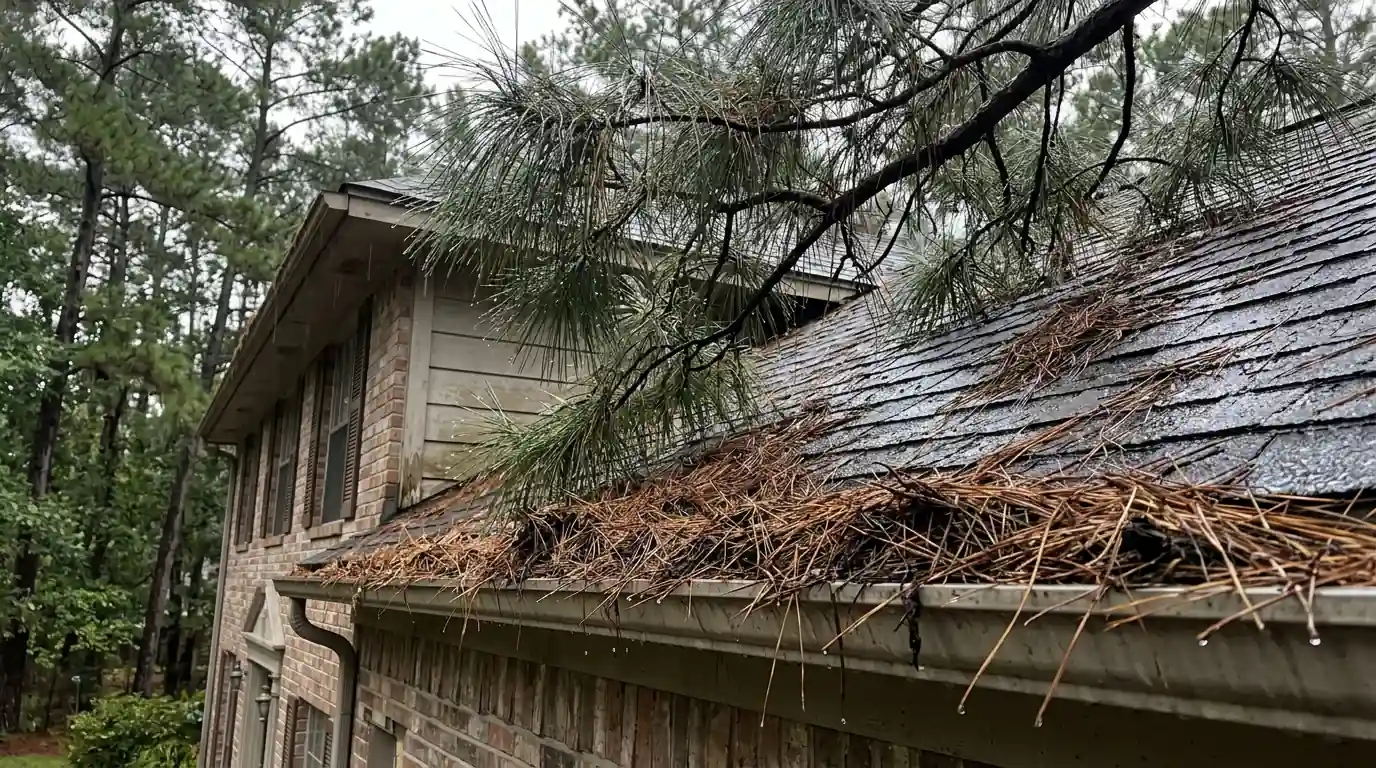
Gutters that overflow weeks after a cleaning, or a valley that stays dark with packed needles, point to the tree directly above. We thin the limbs that drip straight into those spots and cut back any hanging over the valley line. That lowers the load, but it will not stop leaf drop, since wind carries leaves from the whole canopy. Pines are the hard case: their needles fall from high above the roof, so clearance helps less under a tall pine.
Chimneys and vents
Leaves piled on a chimney cap, or a limb hanging over a plumbing vent or flue, deserve attention first. Dry leaves near a working flue are a fire risk, and swaying limbs can knock caps loose or block vents. We cut those limbs well back from the stack, so wind sway cannot carry them near it, and check the attic vents and roof turbines along that same side of the house. Satellite dishes blocked by new growth get the same cut.
Squirrel bridges
Chewed soffit corners, droppings in the attic or scratching overhead at dawn usually trace back to a limb that reaches the roofline. Squirrels jump farther than most people think, so we cut back every limb touching the eaves or sitting close above the roof, not only the one you see them use. Cutting the bridge closes their easiest route. Any hole already chewed still needs sealing, and a squirrel can still climb the siding or a downspout to get back up.
Questions about your tree? Talk to a crew lead.
Call (704) 839-2139Warning signs
Roof damage from trees
Limbs on shingles
Branch tips resting on the roof or brushing it in wind.
Gutters spilling over
Rain spilling over the edge where leaves packed the trough.
Worn shingle patches
Bare spots where a swaying limb rubbed the granules off.
Chewed eave corners
Gnawed soffit wood near a limb that reaches the roof.
Chimney cap debris
Dry leaves or twigs collecting on the cap or flue.
Damp, mossy slopes
Green growth or dark streaks where the roof stays damp.
Local conditions
Roof Limb Clearance in north Houston: what local conditions change
Two months before Beryl arrived, the May 2024 derecho left more than 900,000 Houston-area customers without power. A line of thunderstorms gives far less notice than a hurricane, so we treat roof clearance as spring work rather than a June scramble. A limb already resting on the shingles has no room left to swing; in gusts it drags across them.
Sources: radio.kttz.org
Step by step
Taking limbs off the roofline
Roofline walk
We circle the house and mark every limb over the roof.
Rigging above
The climber ties in higher so each piece can be lowered.
Sectioned cuts
Long limbs come off short, roped down by the ground crew.
Final cuts
Last cuts land at a union just past the eave line.
Cleanup check
Roof, gutters and yard are cleared, then we walk it again.
What moves the price
What sets a clearance price
Three things set a clearance price: how many limbs reach the house, how high the roof sits, and how carefully each piece must be lowered past gutters and glass.
Roof height
A steep two-story roof means more rigging and slower lowering than a ranch.
Limb size
Heavy limbs come down in more pieces, each one roped, adding climbing time.
What sits below
Skylights, solar panels, AC units and patios under the cut slow each lowering.
Brush access
Backyard work behind a fence means carrying brush to the street by hand.
Far enough that the limb cannot touch the roof when wind swings it or rain weighs it down. That varies by limb and species, so we judge each one.
Usually not. Climbers work from the tree, cutting and lowering pieces on ropes. If someone must step onto a low roof to clear debris, we tell you first.
Yes, carefully. Panels cannot take a dropped limb, so every piece over them is lowered on a rope, and the crew keeps leaves and sawdust off the glass.
Fast growers like water oak and sweetgum usually reach the roof again within a few seasons; live oaks and pines take longer. A winter look tells you when.
Any season works, though bare winter branches on sweetgums and elms show the structure best. Before June is ideal, so limbs are off the roof before hurricane season.
No. Guards keep leaves out of the trough, but limbs still scrape shingles, drop debris in valleys and give squirrels a ramp. Clearance and guards solve different problems.
Related work