Answered 24/7 for storm calls
Emergency tree removal across north Houston
We answer the phone 24/7. Say where the tree fell and what it touches; we plan the make-safe from there.
Phone answered 24/7 · office in Spring, TX
- Answered 24/7
- Make-safe first
Updated October 2026
 Storm & Emergency
Short answer
For emergency tree removal in Houston, call any hour: the phone is answered 24/7. The first visit takes the threatening weight off the house, car or street. The full take-down, chipping and stump work follow in daylight, when every piece can be rigged and lowered.
The job
Why make-safe comes first
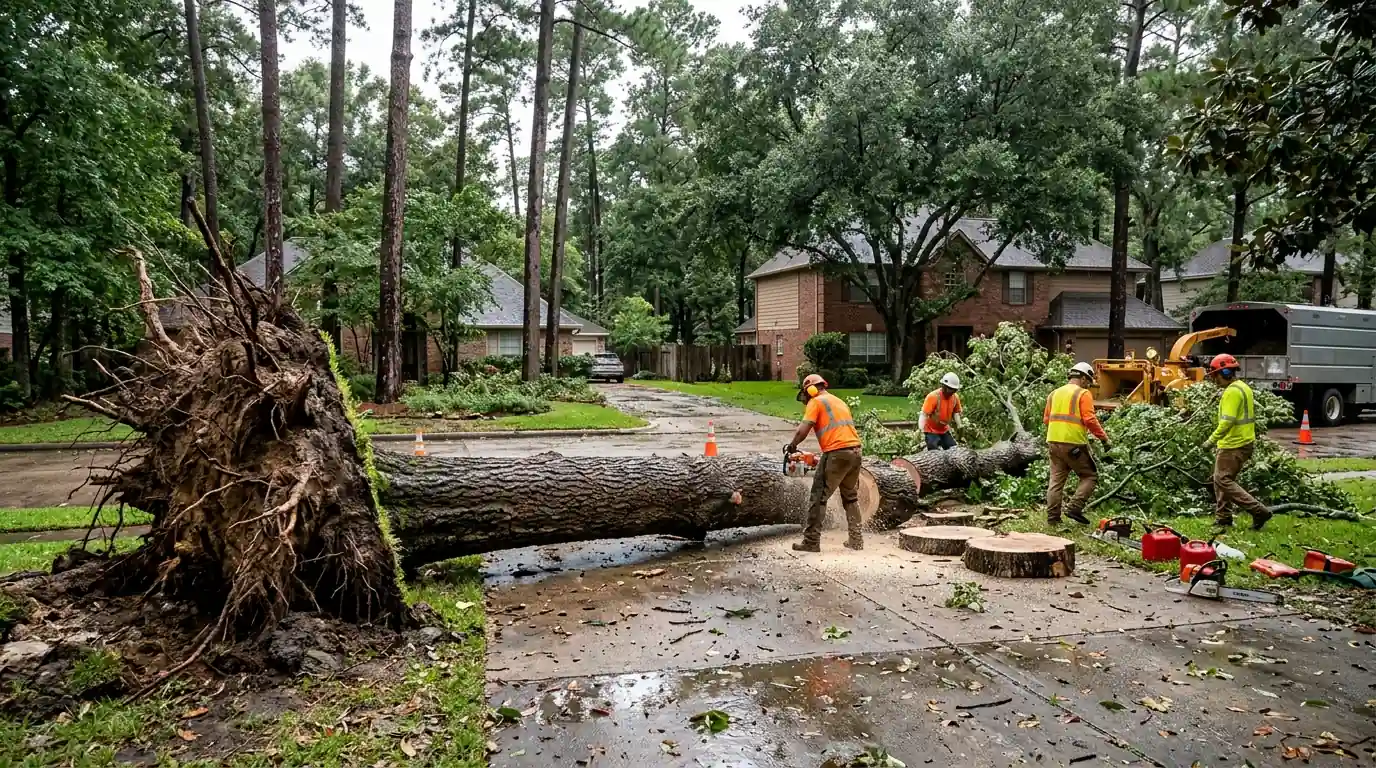
A tree that failed in a storm is still moving. Wet clay lets the root plate settle, gusts work the crown, and a cracked trunk can let go hours later. At night our job is to stop the next failure, not finish the tree.
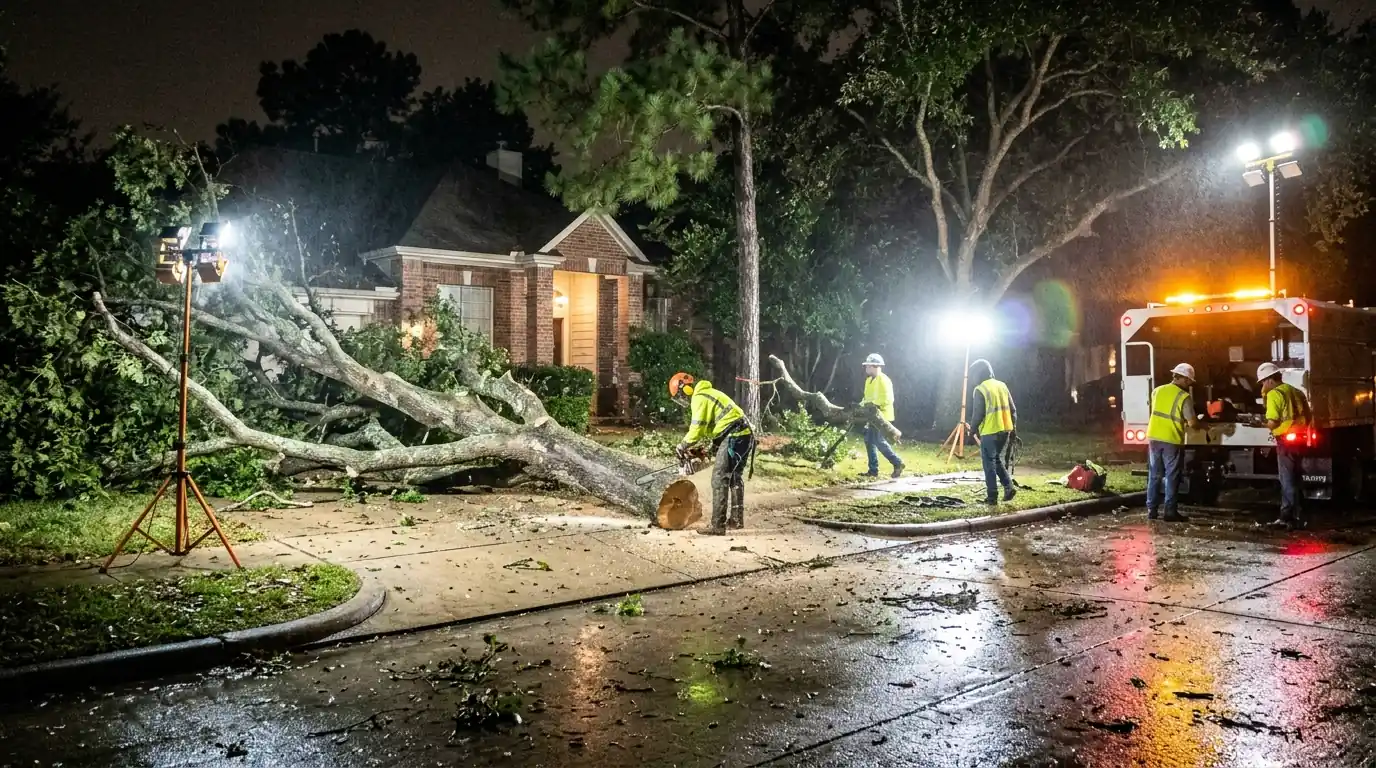
That means cutting the weight off the roof or drive, tying back anything that still swings, and taping off the rest. Felling, sectioning on a lowering line and grinding the stump wait for daylight, when the climber can see every crack.
Tree blocking drive or street
A trunk across the drive traps cars; across the street it blocks neighbors and emergency traffic. If no wire is involved, we cut from the crown end toward the root plate, opening a lane first. Limbs pinned under the trunk act like spring poles and can whip when cut, so the sawyer relieves them from the safe side. The last cut near the roots waits for a plan, because a freed root plate can tip back upright into its hole.
Hard lean after a storm
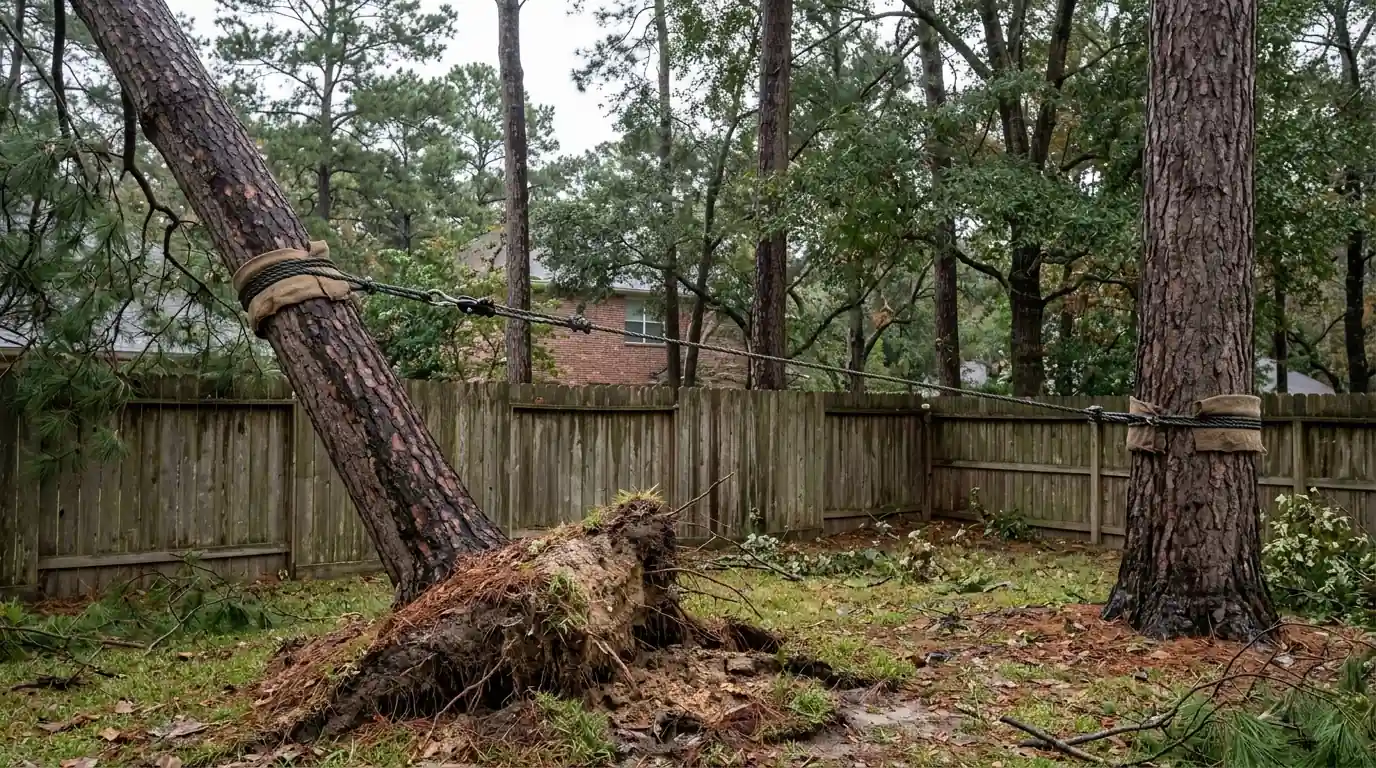
A fresh lean shows at the base: a crack or mound of soil on the side away from the lean, roots snapped, lawn lifting. In saturated clay that root plate can keep rolling, so nobody climbs it. At night we set a tie-back from the ground with a throwline, run to a sound anchor away from the house. In daylight it is felled with a pull line steering it, or picked apart by crane when no safe drop zone exists.
Split or cracked trunk
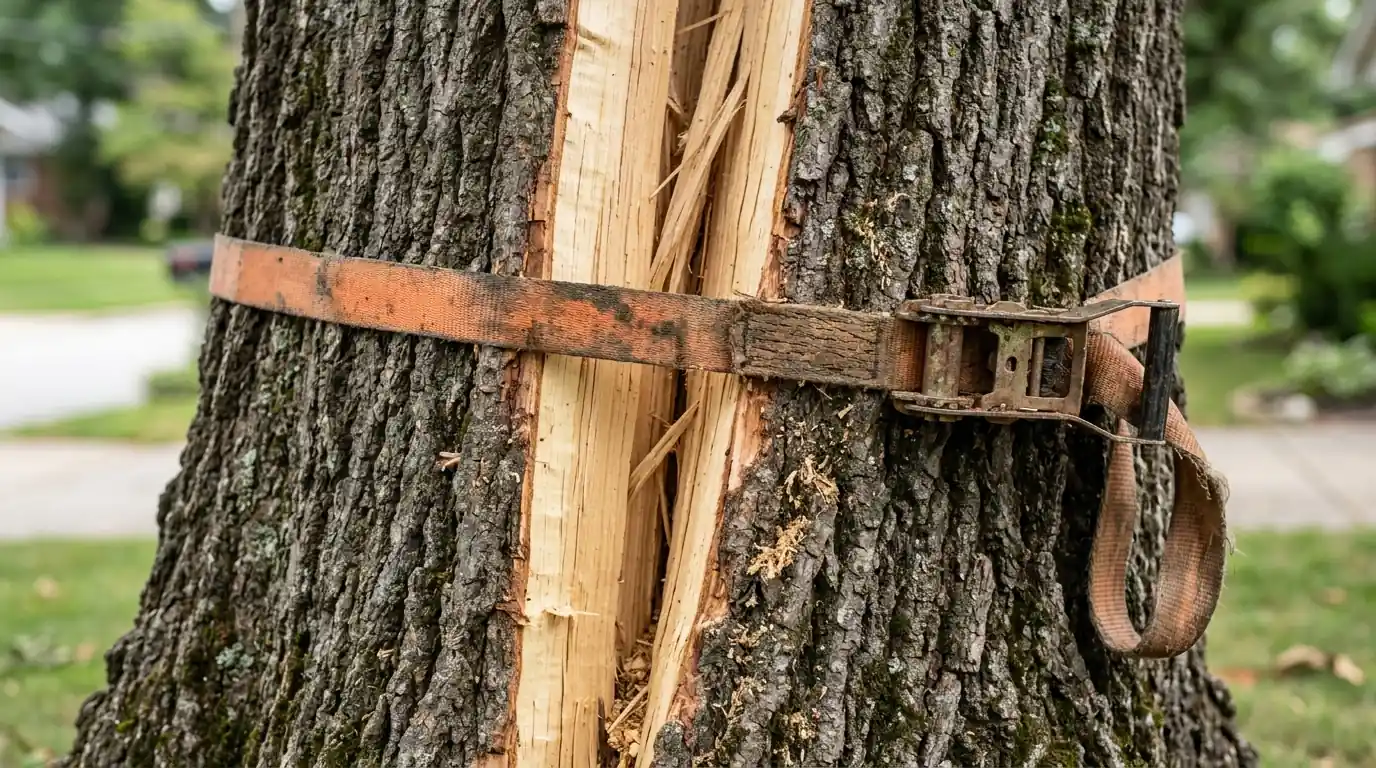
A split usually opens where two stems meet with bark pinched between them, called included bark. After a storm the seam shows fresh wood and the gap works in wind. Felling a cracked trunk whole invites a barber chair, where the stem tears upward and kicks back. So we strap the stems, then lower each one in sections. A young union can sometimes be saved with through-rod bracing; a split main trunk on a mature tree usually must come down.
After-hours make-safe visit
Night work stays inside what the crew can see and control under work lights. Usually that means cutting the load off the roof so the damage stops growing, opening one way in and out for cars, and lowering anything hanging over a door. If the sawyer cannot see where a piece will hinge and fall, that cut waits. Before anyone leaves, the crew lead walks you through what is left, what is holding it, and what the daylight removal involves.
Questions about your tree? Talk to a crew lead.
Call (704) 839-2139Warning signs
Signs it cannot wait
Loaded roof
A trunk or limb pressing shingles or the ridge.
Worsening lean
The crown shifted since the storm; soil is lifting.
Fresh crack
A pale seam that opens and closes in gusts.
Hung pieces
Broken limbs caught above a door, drive or walkway.
Wires touching
A line touching the tree: stay back, call CenterPoint.
Trapped cars
A trunk across the only driveway, no way out.
Timing
Night, then daylight
Two things set the clock: what the tree rests on, and how much is still loaded. A trunk across open lawn can be cut and stacked in one visit. A tree on the roof, a split stem under tension, or a lean toward the house usually means a night make-safe and a daylight return. Rain stretches both.
Local conditions
Emergency Tree Removal in north Houston: what local conditions change
The May 2024 derecho cut power to more than 900,000 customers around Houston, and Beryl arrived two months behind it. By Texas A&M Forest Service's estimate, Beryl's winds damaged roughly half of Greater Houston's trees, most of them older trees. Back-to-back storms matter here: a tree that rides out one blow can enter the next with hidden cracks or loosened roots.
Sources: radio.kttz.org, communityimpact.com
Do it yourself?
What you can do tonight
Fine to handle yourself
- Keep everyone out of the fall zone.
- Photograph the damage from a safe distance.
- Move cars only without passing beneath it.
Leave to a crew
- Loaded trunks: tension can kick a saw.
- Wood near wires: CenterPoint first, then us.
- Roof loads: dropped pieces punch through decking.
Step by step
From call to cleanup
You call
Tell us what it touches: roof, car, wires or lawn.
Hazard check
The crew lead reads loads, tension and any line contact.
Make-safe cuts
Weight comes off; swinging pieces get tied back or lowered.
Daylight removal
The tree is roped down in sections or felled clear.
Chip, haul
Brush is chipped, wood hauled, and the stump plan agreed.
What moves the price
What sets emergency prices
Angi's 2026 Houston figures put most removals between $197 and $1,972; treat those as planning ranges. Emergency jobs are priced on hazard, hour and rigging.
Structure load
Weight on a roof or car means rigged, slow cuts, not felling.
Night work
Make-safe work under lights runs slower than the same cuts in daylight.
Stored tension
Wind-loaded trunks and pinned limbs need relief cuts and tie-backs before removal.
Line contact
Wood touching a line waits until CenterPoint makes it safe to cut.
Cost data: angi.com
Read the storm-season checklistRarely. A young tree with intact roots can be stood up and staked, but a mature tree with a heaved root plate has torn its anchors.
A range, yes, once we know the size, what it rests on and what sits below it. The firm number comes on site.
The make-safe targets what the next gust could bring down: hung pieces, a cracked stem, a lean toward the house. Bigger cuts wait for calmer wind.
A small root plate can sometimes be cut free, tipped into its hole and ground. Large plates are broken up and hauled, and the crater backfilled.
Only if anyone is hurt or trapped, or a downed line is sparking. Otherwise call us, and report line contact to CenterPoint.
Yes. A make-safe can stop at a broken top or one split stem, and the rest is judged in daylight for pruning or cabling.
Related work