Pruning and yard trees
How to Prune a Crape Myrtle in Houston Without Topping It
Every winter, Houston streets fill with crape myrtles cut back to bare stubs. The trees survive it, but they pay for it. Here is what to cut, when, and how to bring back a tree that was topped.
Phone answered 24/7 · office in Spring, TX
By Ursula Lusk, Tree Guides EditorUpdated
 Tree advice
Short answer
In Houston, prune crape myrtles in late winter, before spring growth starts, and limit the work to suckers, crossing limbs, dead wood and branches growing into the center. Texas A&M AgriLife horticulturists warn against topping, nicknamed crape murder, because it leaves knobby stubs and whippy sprouts that bend under heavy blooms. A crape myrtle sized for its spot needs little pruning.
What crape murder does to a crape myrtle
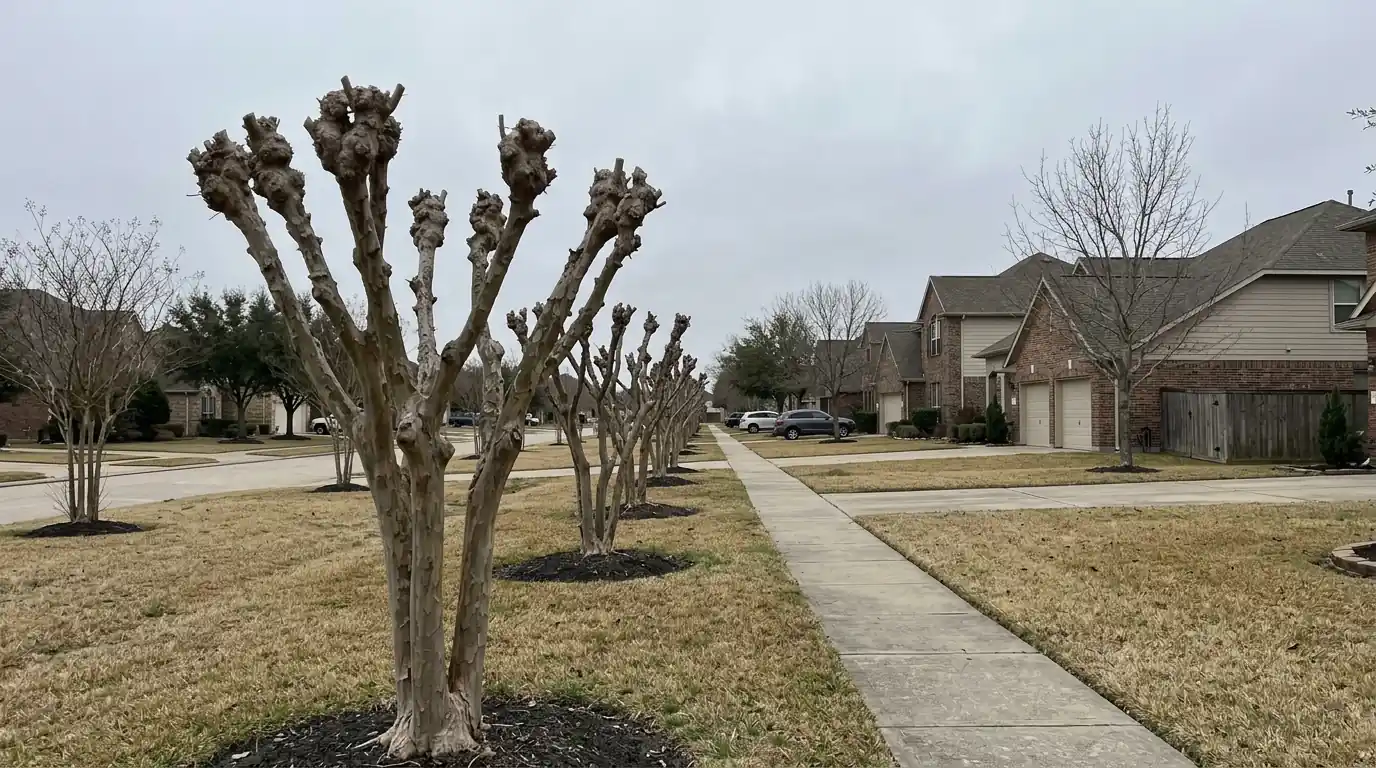
Topping means cutting every trunk and limb back to the same height, often to bare stubs at shoulder level. The tree answers with a burst of thin shoots just below each cut. Those shoots grow fast, carry big flower clusters, and bend or snap under the weight after a summer rain.
Repeat it every winter and swollen knobs, often called knuckles, form where the cuts keep landing. The tree loses its vase shape and the smooth, peeling bark that makes a mature crape myrtle worth looking at in January. It also spends stored energy regrowing wood it already had, year after year.
When to prune a crape myrtle in Houston
Late winter is the window, while the tree is dormant and before new growth pushes out. With the leaves gone you can see every crossing limb and every sucker, and new spring growth soon hides the cuts.
Summer is for light work only. You can snip spent flower clusters and pull suckers as they appear, but save structural cuts for the dormant season. Heavy cuts in fall are the worst timing of all, since any tender regrowth meets the first cold snap.
After a hard freeze, hold off. Freeze damage on a crape myrtle often looks worse in February than it is, and spring leaves show where live wood ends. Cut dead stems back to that point, or to the ground if whole trunks died, once new growth makes the line clear.
The five cuts a crape myrtle actually needs
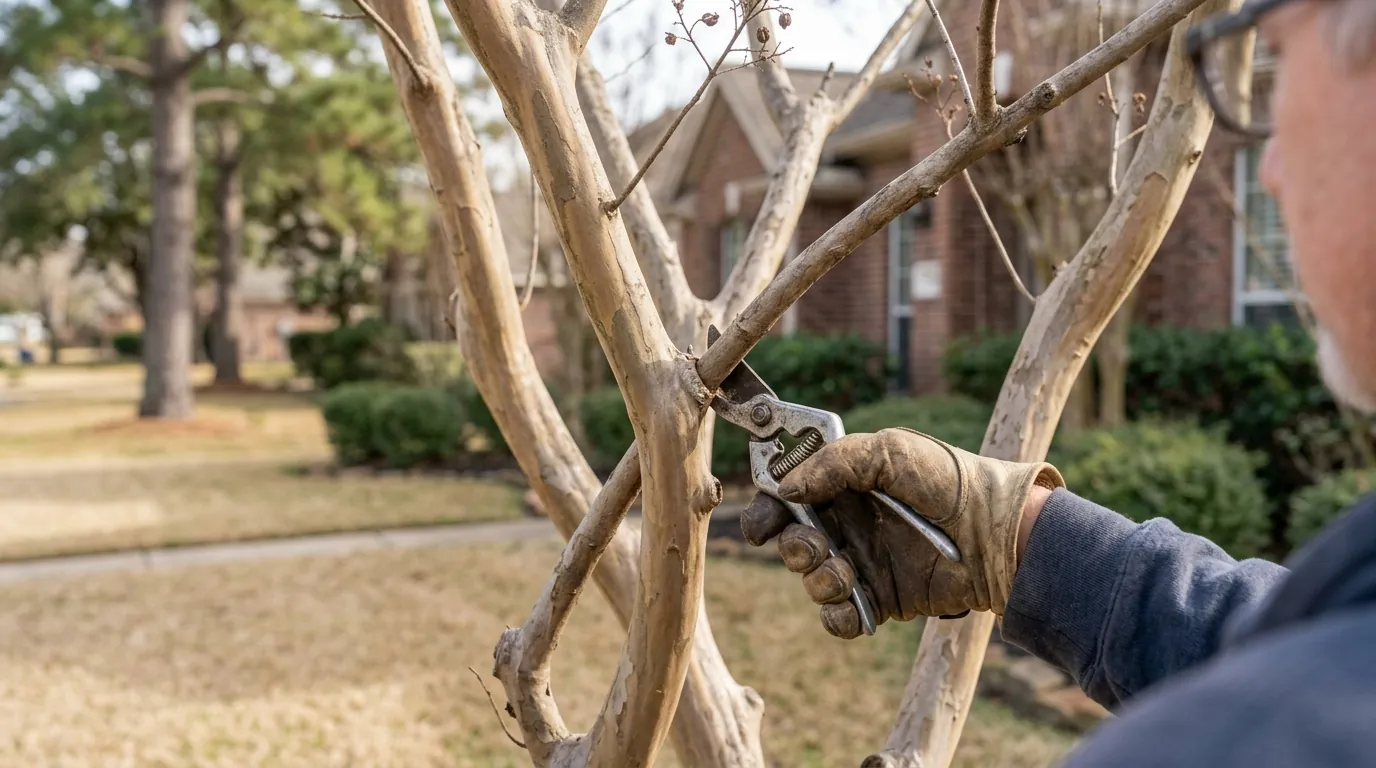
Good pruning removes whole branches where they start, back to the trunk or a larger limb, just outside the slightly swollen collar. It never leaves a stub halfway along a limb, because a stub dies back and the sprouts below it are weakly attached.
- Suckers sprouting from the base or roots, cut flush at the ground.
- Crossing or rubbing branches, keeping the better placed one of each pair.
- Branches aimed into the center of the canopy, where they crowd the middle.
- Dead or broken wood, cut back to live tissue.
- Low side shoots on the trunks, to show the bark and clear the walk.
Topped tree in the front bed?
Ring us for a restoration plan: which shoots stay, which knobs go, and over how many seasons.Making the cut on a crape myrtle limb thicker than your thumb
Small shoots come off with one clean pruner cut. Anything heavier needs three cuts, or the falling limb tears a strip of bark down the trunk and leaves a wound that closes badly.
- Undercut the limb a short way out from the trunk, about a third of the way through.
- Cut from the top a little further out, so the limb drops without tearing.
- Remove the stub with a final cut just outside the branch collar.
- Leave the collar intact, and never cut flush into the trunk itself.
Seed heads: cut them, or leave them for winter?
After the flowers fade, crape myrtles set clusters of round seed capsules that turn brown and hang on into winter. Clipping spent clusters before seeds form can bring a second, smaller round of bloom on many varieties. On a young tree, clipping heavy clusters also takes weight off thin branches that bow after rain. On a tall tree the job is cosmetic, and leaving the seed heads does the tree no harm.
If you clip them, take only the cluster and a short length of stem. Cutting further down to reach every pod drifts back toward topping.
Bringing back a crape myrtle that was already topped
A topped tree is not ruined. Recovery takes a few seasons, and the right path depends on how many years of knobs it carries and how big it wants to grow.
Be honest about the last row of the table below. Most topping starts with a tall variety planted under the eaves, beside a garage or under a wire. The mature height on the tag decides how much pruning a crape myrtle will ever need. In those spots, a dwarf variety, a yaupon holly or a redbud gives the same small-tree effect without the yearly cut.
| Approach | What it involves | Best for |
|---|---|---|
| Thin the sprouts | Keep two or three strong, well-spaced shoots per knob, remove the rest | Trees topped once or twice |
| Cut below the knobs | Remove each knuckle back to clean wood, then train new shoots | Trees with years of knob buildup |
| Cut to the ground | Take all trunks down, then choose a few new stems to grow on | Small varieties with badly scarred trunks |
| Replace it | Plant a variety whose mature size fits the spot | Trees that will always outgrow the space |
When a crape myrtle job needs a crew
Most homeowners can handle a small crape myrtle with hand pruners, loppers and a pole saw from the ground. Call a crew when the trunks are too tall to reach without a ladder, when limbs sit near the line to the house, or when years of knobs need a restoration plan.
Our crape myrtle pruning visits follow the cuts above, and they pair well with shrub and hedge trimming or young tree pruning in the same beds. Limbs touching wires go to trimming near power lines instead.
It can make single flower clusters larger, but they sit on thin shoots that bend or break under the weight. An untopped tree carries more, smaller clusters across a stronger canopy, and it keeps its natural shape.
Light work, such as removing suckers, dead wood or a rubbing branch, is fine any time. Save bigger structural cuts for the next dormant season, so the tree is not regrowing wood in the middle of a Houston summer.
Enough to look balanced, usually a few strong, evenly spaced trunks rather than a thicket. Remove weak trunks and new suckers at the base, and keep trunks that lean away from each other so the canopy opens like a vase.
Cut them as soon as they appear, flush with the trunk or the root they rise from. Short stubs sprout again. Steady removal through the growing season is far easier than one big cleanup each winter.
Yes. A tall variety under the eaves will always push into the roof, and yearly topping is the usual response. Choose by mature height, or move a young tree to open ground during the dormant season.